Purchase journey for broadband. Easily compare, decide and buy a broadband plan on Singtel.com
I consolidated 100+ fragmented broadband purchase forms into one scalable flow – helping customers confidently compare, choose, and buy the right plan.
Role
Led product design, supported user research, and created modular design construct
Timeline
0ct – Dec 2024
Purchase journey for broadband. Easily compare, decide and buy a broadband plan on Singtel.com
I consolidated 100+ fragmented broadband purchase forms into one scalable flow – helping customers confidently compare, choose, and buy the right plan.
Role
Led product design, supported user research, and created modular design construct
Timeline
0ct – Dec 2024
Context
Customers were highly engaged at catalogue pages but conversion rate remained low.
Issue #1
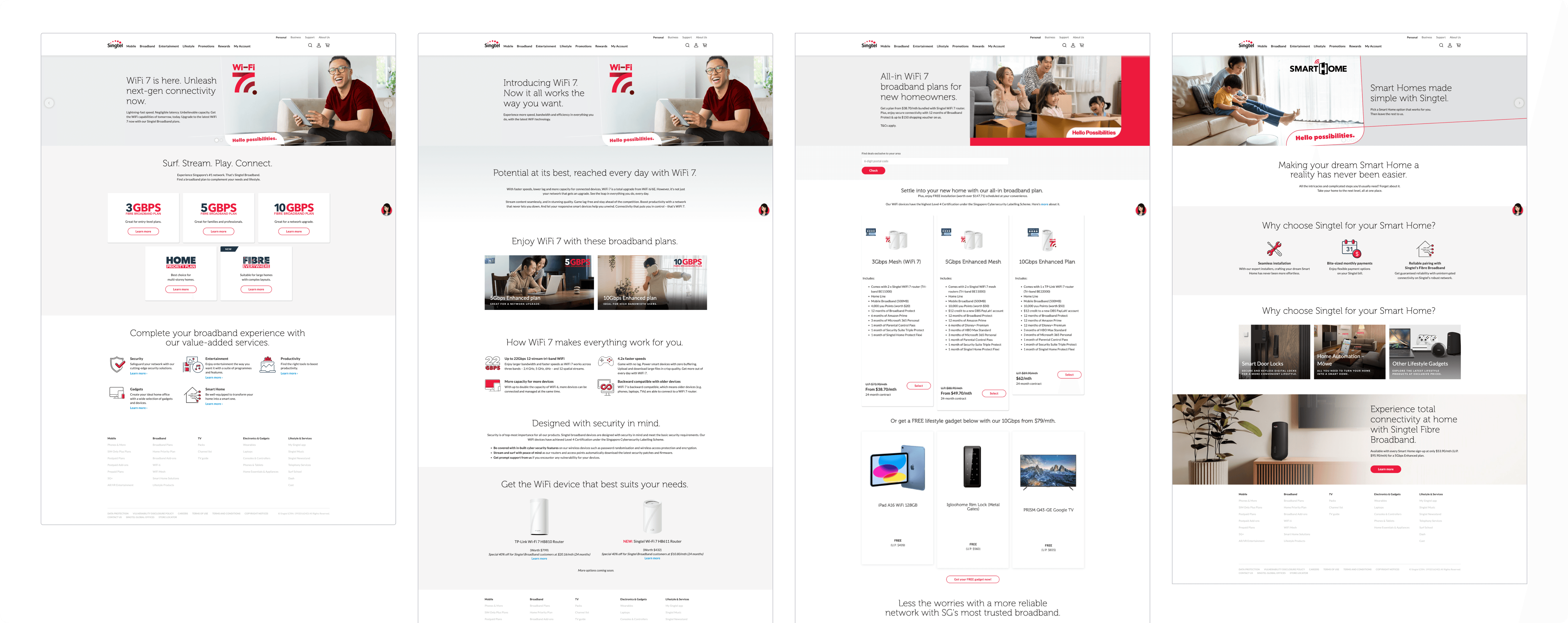
>10 marketing pages creates a maze of overlapping information
Issue #2
Unclear differentiation between plans makes comparison difficult
Issue #3
Inconsistent checkout forms adds confusion to understanding and friction to submission
Example of 4 marketing pages that appear similar and feature overlapping information.
Context
Customers were highly engaged at catalogue pages but conversion rate remained low.
Issue #1
>10 marketing pages creates a maze of overlapping information
Issue #2
Unclear differentiation between plans makes comparison difficult
Issue #3
Inconsistent checkout forms adds confusion to understanding and friction to submission
Example of 4 marketing pages that appear similar and feature overlapping information.

How might we simplify the flow of information to match our customers' mental model?
How might we simplify the flow of information to match our customers' mental model?
Key approach
Breaking down the product construct and customer journey into its lego pieces
I kicked-off this project by conducting an ideation workshop within the design team (2 designers, 2 researchers). Starting from a clean slate was to set aside biases from the current journey.
We were unanimous in our hypothesis: making plans directly comparable based on internet needs and having a guided purchase process will improve online conversion rates.
With some refinement from this initial idea, we took it to real customers.
The artifact
Seen below is the wireframe put together from our first workshop. This base was useful to validate with product owners and iteration against varying scenarios.
Key approach
Breaking down the product construct and customer journey into its lego pieces
I kicked-off this project by conducting an ideation workshop within the design team (2 designers, 2 researchers). Starting from a clean slate was to set aside biases from the current journey.
We were unanimous in our hypothesis: making plans directly comparable based on internet needs and having a guided purchase process will improve online conversion rates.
With some refinement from this initial idea, we took it to real customers.
The artifact
Seen below is the wireframe put together from our first workshop. This base was useful to validate with product owners and iteration against varying scenarios.

Research
Customers look for assurance in the details to build confidence for purchase.
Customers seek information on context of use, service reliability and value (price vs features). They looked for brief and precise points to get oriented, then scanned for contextually-placed details to answer questions often relating to terms of purchase or use.
Format
Conducted 5 usability interviews with broadband customers across seniority, occupations, family size, and telcos.
Research
Customers look for assurance in the details to build confidence for purchase.
Customers seek information on context of use, service reliability and value (price vs features). They looked for brief and precise points to get oriented, then scanned for contextually-placed details to answer questions often relating to terms of purchase or use.
Format
Conducted 5 usability interviews with broadband customers across seniority, occupations, family size, and telcos.

The new purchase flow
A modular purchase flow similar to major e-commerce experiences and familiar to users.
Designed for customers to feel confident committing to the service. This metric was more important than speed of checkout. Each page had a clear objective and grouped relevant information in each section.
The new purchase flow
A modular purchase flow similar to major e-commerce experiences and familiar to users.
Designed for customers to feel confident committing to the service. This metric was more important than speed of checkout. Each page had a clear objective and grouped relevant information in each section.

Interface design
Step-by-step in every frame with precise and functional detail
Interface design
Step-by-step in every frame with precise and functional detail
1.
Contextualising the value of broadband plans to tangible use cases.
Test participants could relate and confidently select a plan suitable to their use case.

1.
Contextualising the value of broadband plans to tangible use cases.
Test participants could relate and confidently select a plan suitable to their use case.
2.
Multiple pages with steppers created the right cadence of committing to the purchase.
This helped set the right expectation around the pace of purchase. Test participants unanimously remarked the overall flow felt smooth.

2.
Multiple pages with steppers created the right cadence of committing to the purchase.
This helped set the right expectation around the pace of purchase. Test participants unanimously remarked the overall flow felt smooth.
3.
Catering one decision per frame manages the customer's mental load.
Test participants liked that they made key broadband-related choices first, before moving on to add-ons.

3.
Catering one decision per frame manages the customer's mental load.
Test participants liked that they made key broadband-related choices first, before moving on to add-ons.
4.
Explaining details and terms simply.
Test participants appreciate having more details, especially any that might affect overall cost.

4.
Explaining details and terms simply.
Test participants appreciate having more details, especially any that might affect overall cost.
Reflections
Prioritise recommendations when speaking with stakeholders
The plan description reframe was a big change for the business. In future, I’d recommend changes in increments and with metric milestones.
Ask the "answered" question
New discoveries and use cases kept surfacing after requirements and approved reviews. An approach I would try in future would be a workshop with all stakeholder representatives to stress test use cases.
Reflections
Prioritise recommendations when speaking with stakeholders
The plan description reframe was a big change for the business. In future, I’d recommend changes in increments and with metric milestones.
Ask the "answered" question
New discoveries and use cases kept surfacing after requirements and approved reviews. An approach I would try in future would be a workshop with all stakeholder representatives to stress test use cases.
Reflections
Prioritise recommendations when speaking with stakeholders
The plan description reframe was a big change for the business. In future, I’d recommend changes in increments and with metric milestones.
Ask the "answered" question
New discoveries and use cases kept surfacing after requirements and approved reviews. An approach I would try in future would be a workshop with all stakeholder representatives to stress test use cases.
Next project
The Dispensary Design System
Next project
The Dispensary Design System
Next project
The Dispensary Design System