Designing for Scale at Singtel.com: Faster Launches, One Cohesive Experience, Built for Change
As business, marketing, and product teams pursued their own goals independently, we ended up with a fragmented website experience.
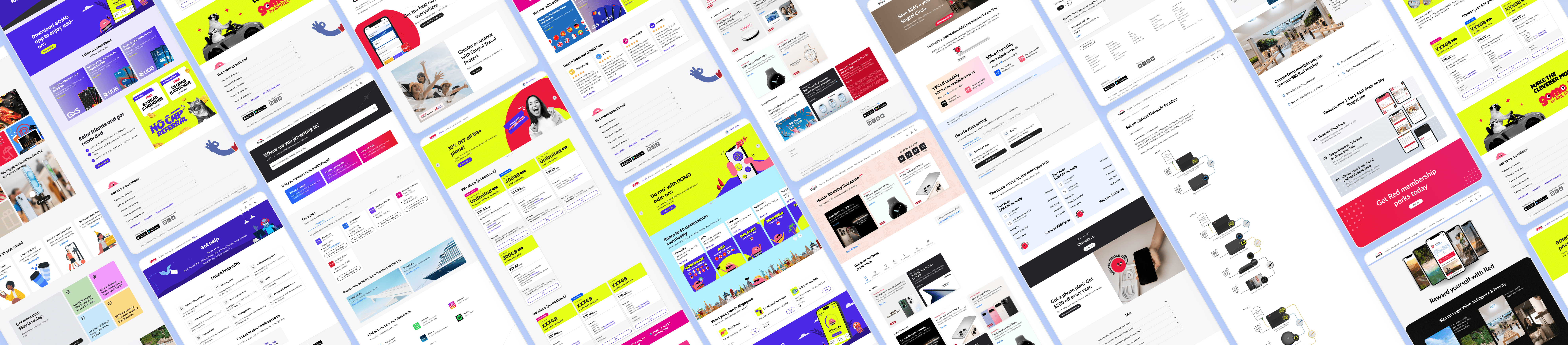
We set out to fix this. The result is a design system now live on 200+ pages, with an ongoing goal to migrate all of Singtel.com onto it.
Role
Design system strategy, UX research & audit, migration planning & process design
Timeline
2026 – Ongoing
Designing for Scale at Singtel.com: Faster Launches, One Cohesive Experience, Built for Change
As business, marketing, and product teams pursued their own goals independently, we ended up with a fragmented website experience.
We set out to fix this. The result is a design system now live on 200+ pages, with an ongoing goal to migrate all of Singtel.com onto it.
Role
Design system strategy, UX research & audit, migration planning & process design
Timeline
2026 – Ongoing
Context & challenge
Using a new CMS initiative to improve content outcomes across Singtel.com
The new CMS meant new pages would be published there, while a separate effort was needed to migrate existing pages over.
The challenge was the complexity of page ownership and creation. Page owners were segregated by product, brand, and function — each unit working independently. Some units created pages on their own; others involved the CMS authoring team and mine.
With this initiative, we worked with the CMS product owner to establish a way to produce better webpages.
Context & challenge
Using a new CMS initiative to improve content outcomes across Singtel.com
The new CMS meant new pages would be published there, while a separate effort was needed to migrate existing pages over.
The challenge was the complexity of page ownership and creation. Page owners were segregated by product, brand, and function — each unit working independently. Some units created pages on their own; others involved the CMS authoring team and mine.
With this initiative, we worked with the CMS product owner to establish a way to produce better webpages.
The problems
Multiple owners and a legacy system led to patchwork content and design.
Issue #1
Every page was overstuffed with banners and users tuned them out.
Issue #2
Differing presentation of products and services across pages was confusing
Issue #3
No governance over accessibility of visual outcomes

The problems
Multiple owners and a legacy system led to patchwork content and design.
Issue #1
Every page was overstuffed with banners and users tuned them out.
Issue #2
Differing presentation of products and services across pages was confusing
Issue #3
No governance over accessibility of visual outcomes

How might we design webpages where consistent design and coherent content are easily replicable?
How might we design webpages where consistent design and coherent content are easily replicable?
Stage 1: The simple approach
A selection of templates where content just needed to be dropped in. Easy, fast, replicable standards.
I analyzed 40 pages to understand their content and needs, then designed a set of full-layout templates for stakeholders to choose from.
The goal was for the templates to guide teams toward tighter, more considered content — templates that could fit every type of content.
Stage 1: The simple approach
A selection of templates where content just needed to be dropped in. Easy, fast, replicable standards.
I analyzed 40 pages to understand their content and needs, then designed a set of full-layout templates for stakeholders to choose from.
The goal was for the templates to guide teams toward tighter, more considered content — templates that could fit every type of content.

The uptake: None
Stakeholders found the templates couldn't flex to evolving campaign and product requirements. Content kept outgrowing the templates.
How might we design webpages where consistent design and coherent content are easily replicable let content shape its own coherent flow, while staying consistent across the site as a whole?
How might we design webpages where consistent design and coherent content are easily replicable let content shape its own coherent flow, while staying consistent across the site as a whole?
Stage 2: The reframe
From templates to content blocks — a more fluid, content-first approach
The feedback on the templates was consistent: "Can I place this section on top?" "You have this section in another template — can I use it here too?"
It became clear that content creators liked the section templates individually; the rigid, full-page templates were the problem. What we needed was to break the work down and implement it in a modular way.
This made it easier to publish more pages on the new CMS.
Stage 2: The reframe
From templates to content blocks — a more fluid, content-first approach
The feedback on the templates was consistent: "Can I place this section on top?" "You have this section in another template — can I use it here too?"
It became clear that content creators liked the section templates individually; the rigid, full-page templates were the problem. What we needed was to break the work down and implement it in a modular way.
This made it easier to publish more pages on the new CMS.

Stage 3: Picking up steam
We moved gomo.sg (40+ pages) within three weeks onto the new CMS
This was a strong sign that the new authoring approach could move fast once it worked.
There was still some teething friction points between business, marketing, authors, and our team –– but we took the time to create alignment with walkthrough sessions, content discussions and collaborative iteration.
Stage 3: Picking up steam
We moved gomo.sg (40+ pages) within three weeks onto the new CMS
This was a strong sign that the new authoring approach could move fast once it worked.
There was still some teething friction points between business, marketing, authors, and our team –– but we took the time to create alignment with walkthrough sessions, content discussions and collaborative iteration.

Stage 4: Pushing for change
After successfully applying the new approach to GOMO, I ran a full web audit and created a migration plan for Singtel.com
To push for the same change across Singtel.com, we pulled the full list of URLs (~5,000). I came up with a strategy to contextualize the information, then used Claude to do the heavy lifting. After 7 rounds of review and iteration, I could give our migration team a clear way forward.
We now use this plan to prioritize pages weekly, with check-ins and a monthly migration goal of 50 pages.
Stage 4: Pushing for change
After successfully applying the new approach to GOMO, I ran a full web audit and created a migration plan for Singtel.com
To push for the same change across Singtel.com, we pulled the full list of URLs (~5,000). I came up with a strategy to contextualize the information, then used Claude to do the heavy lifting. After 7 rounds of review and iteration, I could give our migration team a clear way forward.
We now use this plan to prioritize pages weekly, with check-ins and a monthly migration goal of 50 pages.

Where we are now & what’s next
200+ pages and counting on the new CMS, across brands and product verticals
Even with this progress, the work isn't finished. We're creating more modular design options and expanding the component library to better meet content needs.
The other focus is producing better content collectively — likely through monthly workshops on what makes content good, and how to achieve that within our designs and components.
Where we are now & what’s next
200+ pages and counting on the new CMS, across brands and product verticals
Even with this progress, the work isn't finished. We're creating more modular design options and expanding the component library to better meet content needs.
The other focus is producing better content collectively — likely through monthly workshops on what makes content good, and how to achieve that within our designs and components.

Reflections
Complexity of page ownership and creation was a design constraint
Business workflows shape the user experience and as designers, we need learn these rules and their impact early.
But constraints are not blockers
The limits of the CMS, and the network of page owners pushed me toward a clearer, more thoughtful solution.
Reflections
Complexity of page ownership and creation was a design constraint
Business workflows shape the user experience and as designers, we need learn these rules and their impact early.
But constraints are not blockers
The limits of the CMS, and the network of page owners pushed me toward a clearer, more thoughtful solution.
Reflections
Complexity of page ownership and creation was a design constraint
Business workflows shape the user experience and as designers, we need learn these rules and their impact early.
But constraints are not blockers
The limits of the CMS, and the network of page owners pushed me toward a clearer, more thoughtful solution.
Next project
Purchase journey for broadband
Next project
Purchase journey for broadband
Next project
Purchase journey for broadband